Antoni Gaudí beyond the postcards
There are architects who design buildings. And then there is Antoni Gaudí, who seemed to grow them.
You probably know his name. You’ve likely seen these buildings with your own eyes or at least on the photos: the jagged spires of the Sagrada Familia, the mosaic serpent of Park Güell, the undulating limestone face of Casa Milà. But here is the thing about Gaudí – the images never quite explain him. To understand his work, you have to understand the man. And the man is far more surprising than the buildings.
A Sickly child who studied bones
Gaudí was born in 1852 in Reus, Catalonia, the youngest of five children. His father was a coppersmith, and Gaudí would later say that growing up watching his father work metal shaping three-dimensional forms from flat sheets gave him a spatial intuition that no school could teach.
As a child, he suffered from rheumatic fever so severe that he often couldn’t walk to school. Instead, he spent long stretches alone in the Catalan countryside, watching things: how a vine clung to a wall, how a reed bent without breaking, how bones distribute weight. He was, in the most literal sense, educated by nature.
He once said: “The straight line belongs to man; the curved line belongs to God.” This is not metaphor. It is method. And it explains everything.
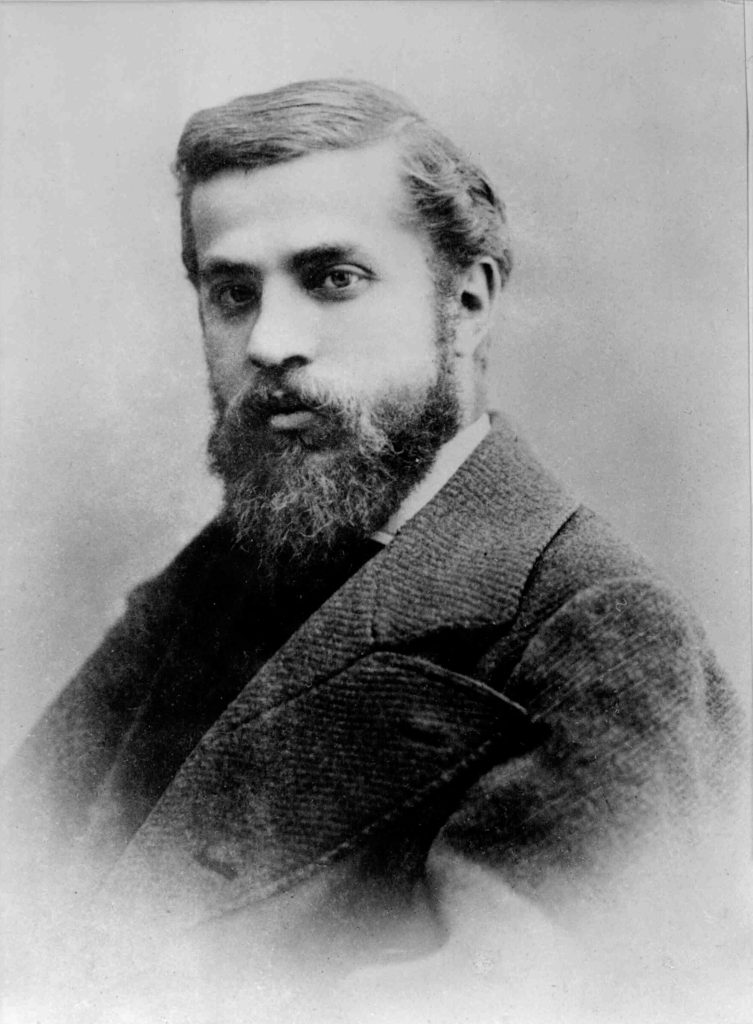
Portrait photograph of Antoni Gaudí i Cornet.
The dandy who became an ascetic
Here is something the tourist brochures rarely mention: Gaudí was, in his youth, something of a dandy. He dressed in expensive suits, traveled by horse carriage, attended the opera, and had gourmet tastes. He was handsome, socially ambitious, and very much interested in being noticed.
Then, gradually, he changed and not gently. The losses came one after another. His father died in 1906 at 93. His niece Rosa, whom he’d raised after she was orphaned, died in 1912 at just 36. His closest collaborator Francesc Berenguer died in 1914. His best friend and lifelong patron, Count Eusebi Güell, in 1918. Each death seemed to strip something away.
By his final years, Gaudí had given up meat, wore the same frayed suits repaired over and over (“as long as they are clean, they are still decent,” he said), and had moved out of his home in Park Güell to sleep in a small cot inside the Sagrada Familia workshop. He refused new commissions. He collected alms in the street to fund construction of the basilica. He walked up to ten kilometers a day often to his favorite church, Sant Felip Neri, for daily confession.
He had become, in the eyes of Barcelona, either a saint or a madman. Possibly both.
A death nobody saw coming and nobody recognized
On the afternoon of June 7, 1926, Gaudí was crossing the Gran Via de les Corts Catalanes on his way to prayer. He stepped back from one approaching tram and was struck by another coming from the opposite direction. He was thrown to the ground, badly injured.
Nobody stopped. Passersby saw a gaunt old man in worn-out clothes, carrying nothing but a copy of the Gospels. They assumed he was a beggar. Taxi drivers refused to take him. A police officer eventually brought him to the Hospital de la Santa Creu, where he received only the rudimentary care given to the poor.
It was not until the following day that the chaplain of the Sagrada Familia visited the hospital and recognized the city’s most famous architect lying in a pauper’s ward.
It was too late. Gaudí died on June 10, 1926, at 73.
His funeral procession moved through Barcelona from La Rambla all the way to the Sagrada Familia, followed by thousands. He is buried in the crypt beneath the church he devoted his life to, the same church that is still, one hundred years later, being finished.
In 2025, Pope Francis declared him Venerable, the latest step in a process that could one day make the architect of Barcelona a saint.
How does a coppersmith’s son become an architect?
Architecture was not an obvious choice, but in hindsight, it was almost inevitable. Growing up watching his father and grandfather shape three-dimensional objects from flat sheets of copper gave Gaudí an instinctive feel for space and form that no classroom could fully teach. Add to that his boyhood habit of lying in fields observing bones, shells, and plants, and you have someone already thinking in structures before he ever touched a drafting table.
At sixteen, he decided: architecture. He moved to Barcelona around 1870, taking on odd jobs to pay his way through school. He was, by all accounts, a mediocre student by conventional measures, he missed classes, turned in unconventional work and frustrated his professors. In one assignment, asked to design a cemetery gate, he submitted instead a detailed drawing of a funeral procession – mourners, a hearse, the whole scene. Not a gate in sight.
That line followed him to graduation. When the school director Elies Rogent signed his diploma in 1878, he declared: “Who knows if we have given this diploma to a madmanor to a genius. Time will tell.” It is one of architecture’s more satisfying predictions.
First works and the encounter that changed everything
Fresh out of school, Gaudí’s first projects were lampposts for Barcelona’s Plaça Reial — functional, elegant, and still standing there today. Hardly a dramatic debut. But that same year, he designed a display case for a Barcelona glove manufacturer, and the piece was sent to the Paris World’s Fair of 1878.
The showcase impressed Catalan merchant Eusebi Güell, who tracked down the artist in Barcelona and became Gaudí’s close friend and an important patron, commissioning the Güell wine cellars, the Güell pavilions, the Palau Güell, Park Güell, and the crypt of the Colònia Güell church. One glove display case, and the course of architectural history shifted.
His first residential project was Casa Vicens, built between 1883 and 1885, a summer house for a Barcelona financier, covered in geometric ceramic tiles, topped by slender minarets, pulling in references from Islamic architecture and the Orient. For a young architect in his early thirties, it was a strikingly confident statement. Nobody in Barcelona had seen anything quite like it.
What followed was a decade of relentless work and widening ambition: El Capricho in Cantabria, the Episcopal Palace in Astorga, the Palau Güell in Barcelona’s old town. He spent until the end of the 19th century producing building after building, each time his sense of direction becoming more prominent. He was absorbing influences from Gothic architecture, from Moorish Spain, from Japanese and Indian design and slowly distilling them all into something that belonged to none of those traditions and entirely to himself.
Rise to fame and the critics who came with it
By the early 1900s, Gaudí’s reputation in Barcelona was real but complicated. In 1900, he received the Barcelona City Council’s award for the best building of the year for his Casa Calvet, his most conventional work and perhaps the only one his critics could stomach. The more ambitious projects, Casa Batlló and Casa Milà, provoked open ridicule. Barcelonans mocked La Pedrera’s undulating limestone facade. The owner of Casa Milà eventually sued him over costs.
It’s worth noting that some of the most famous names of the era were not admirers. George Orwell called the Sagrada Familia one of the ugliest buildings in the world. Picasso reportedly detested it. Salvador Dalí, who understood strangeness, called Gaudí’s work “superbly creative bad taste.” High-handed praise, or a compliment in disguise. Hard to say.
Gaudí’s fame grew internationally during his lifetime, but appreciation of his work began to fade after his death. The rise of the International Style, clean lines, glass, steel, no ornament, made his organic exuberance look like excess. During the Spanish Civil War, the Sagrada Familia workshop was burned and many of his models destroyed. For decades, the question was seriously raised: should the building even be finished?
The true rehabilitation came in the 1960s, when scholars began publishing serious studies of his structural innovations and a new generation of architects started looking at him differently, not as an eccentric romantic, but as a genuine pioneer of structural engineering. The appreciation of his work has only magnified since 1960, with scholars helping bring Gaudí and Catalan Modernisme even greater international renown. The 1992 Barcelona Olympics brought millions of new visitors to the city and to his buildings. UNESCO listed seven of his works as World Heritage Sites between 1984 and 2005. Today, the Sagrada Familia is the most visited monument in all of Spain.
He went from madman to genius on a roughly hundred-year delay.
Architecture without blueprints
Gaudí didn’t trust drawings. He trusted gravity.
For the Sagrada Familia, he built an extraordinary upside-down model using weighted hanging chains. When inverted, these chains formed perfect catenary arches – shapes that naturally distribute forces with minimal stress. What engineers calculate, Gaudí let physics solve. It was structural poetry, and it worked.
He also pioneered the use of hyperboloids, paraboloids, and ruled surfaces – complex geometries that appear fluid and organic but can be built from straight lines. This wasn’t decoration for its own sake. It was engineering that happened to be beautiful.
His relationship with his patron Eusebi Güell, industrialist, intellectual and the man who commissioned some of his greatest works, was central to everything. Güell gave Gaudí something rare: creative freedom and financial backing, without interference. Without Güell, there may have been no Park Güell, no Palau Güell, and possibly no Sagrada Familia as we know it.
The famous works but differently
Casa Batlló is usually described in terms of its dragon-roof or its bone-like columns. But here is the stranger detail: Gaudí never confirmed any of the symbolism. He left it deliberately open. A building that explains itself becomes static, he believed. One that invites interpretation keeps living.
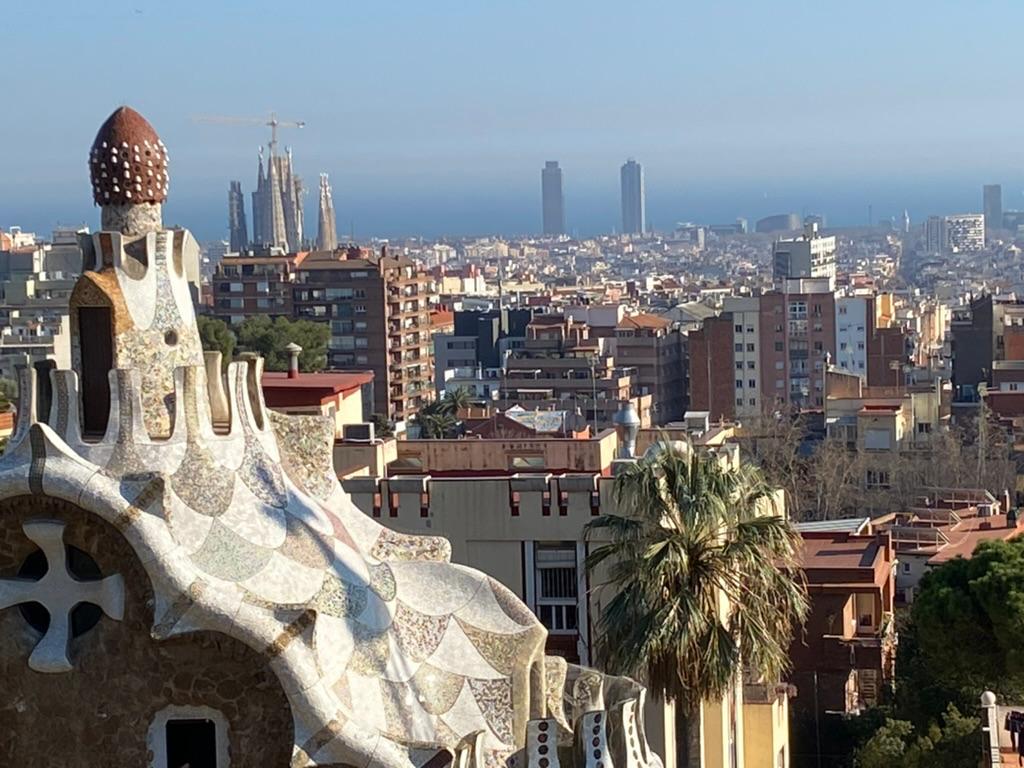
Park Güell was supposed to be a luxury residential development. It failed spectacularly, only two of the planned sixty houses were ever sold. And yet, in failing commercially, it became one of Gaudí’s most complete philosophical statements: a place where the boundary between built and natural simply dissolves. The columns lean like trees. The paths follow the contours of the hill. Broken ceramics, the trencadístechnique – tile every surface in shards of color.
Casa Milà (La Pedrera,“the quarry,” a nickname that was originally an insult) was so unconventional that Gaudí’s clients, the Milà family, actually took him to court over construction costs. They lost as we mentioned above. Gaudí donated the settlement money to charity.
Beyond Barcelona: The Gaudí most people never see
Gaudí’s work doesn’t begin and end in Barcelona. If you travel a little further, a very different side of him appears.
El Capricho, Comillas (Cantabria)
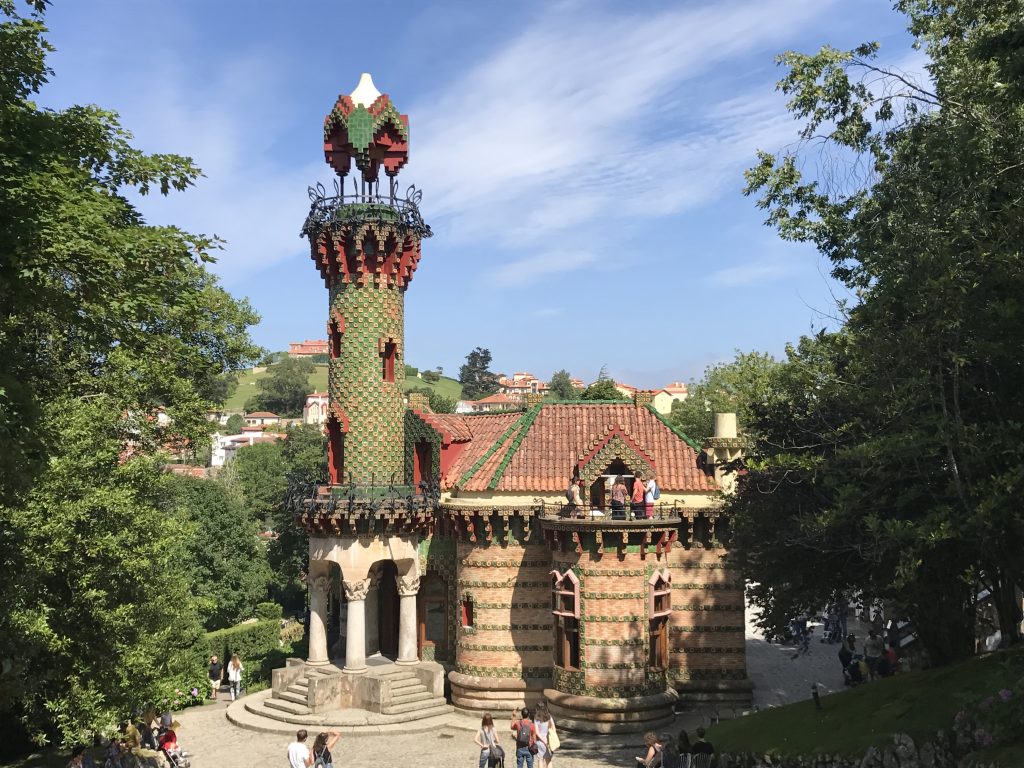
Photo by Triplecaña, CC BY-SA 4.0
Built between 1883 and 1885 for a wealthy local who had made his fortune in Latin America, this summer villa on the northern coast of Spain is unlike anything else Gaudí built. Sunflower-decorated ceramic tiles wrap the exterior, minaret-like towers evoke both Japan and India, and Moorish geometric patterns run throughout. Gaudí was clearly experimenting trying on influences from across the world. The most remarkable footnote: he never actually visited it. The entire construction was supervised by his assistant.
The Crypt of Colonia Güell, Santa Coloma de Cervelló
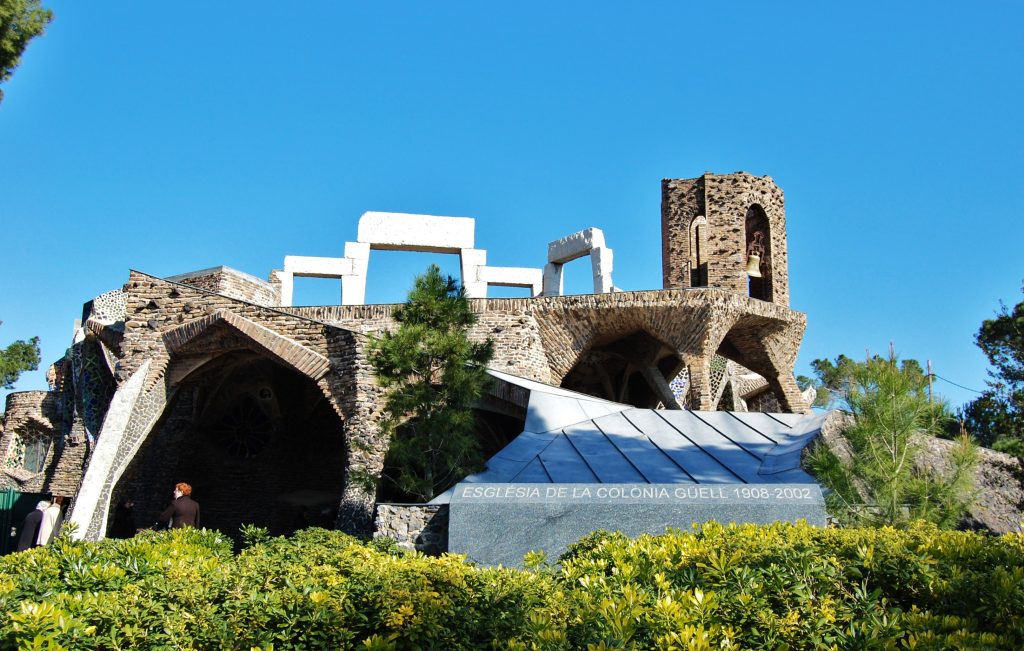
Photo by Maria Rsa Ferre, CC BY-SA 2.0
About 30 minutes from Barcelona lies a town that Eusebi Güell built for the workers of his textile factory. He commissioned Gaudí to design its church. Gaudí worked on it for fourteen years and only finished the crypt. But that crypt is, in the view of many architects, the most technically important thing he ever built. It was his laboratory for the Sagrada Familia: here he tested his catenary arch systems, his inclined columns, his structural logic. Without Colonia Güell, the great basilica would not exist as it does. The crypt is still in use as a church today.
Casa Botines, León
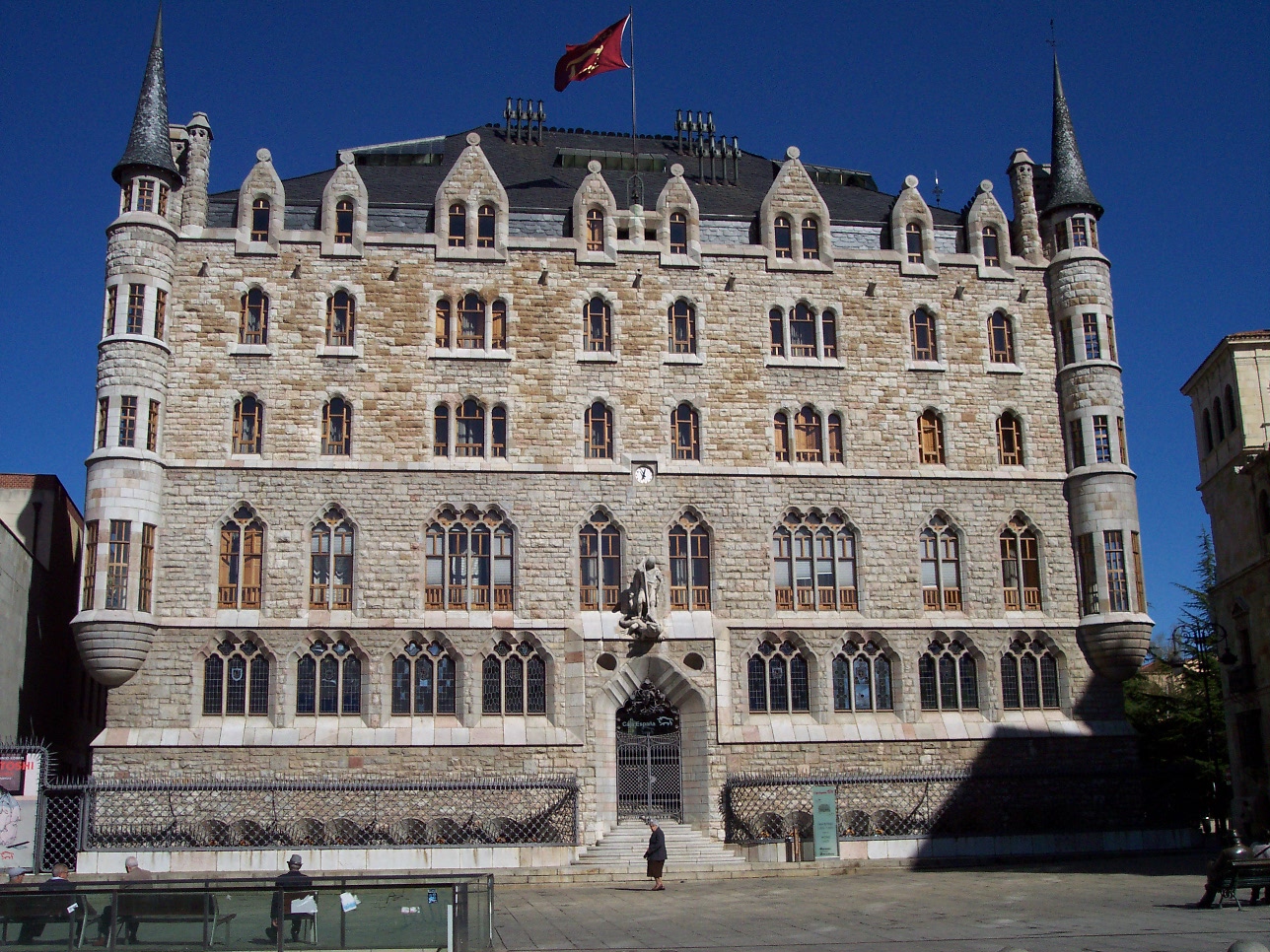
Photo by Rodelar, CC BY-SA 3.0
Completed in just ten months in 1892, this building in the heart of Castilla looks like a medieval fortress. It was commissioned by two textile merchants and recommended by Güell. The Neo-Gothic turrets, the moat, the battlements and above the door, a statue of Saint George slaying the dragon. It is now a museum.
Episcopal Palace, Astorga (Castilla y León)
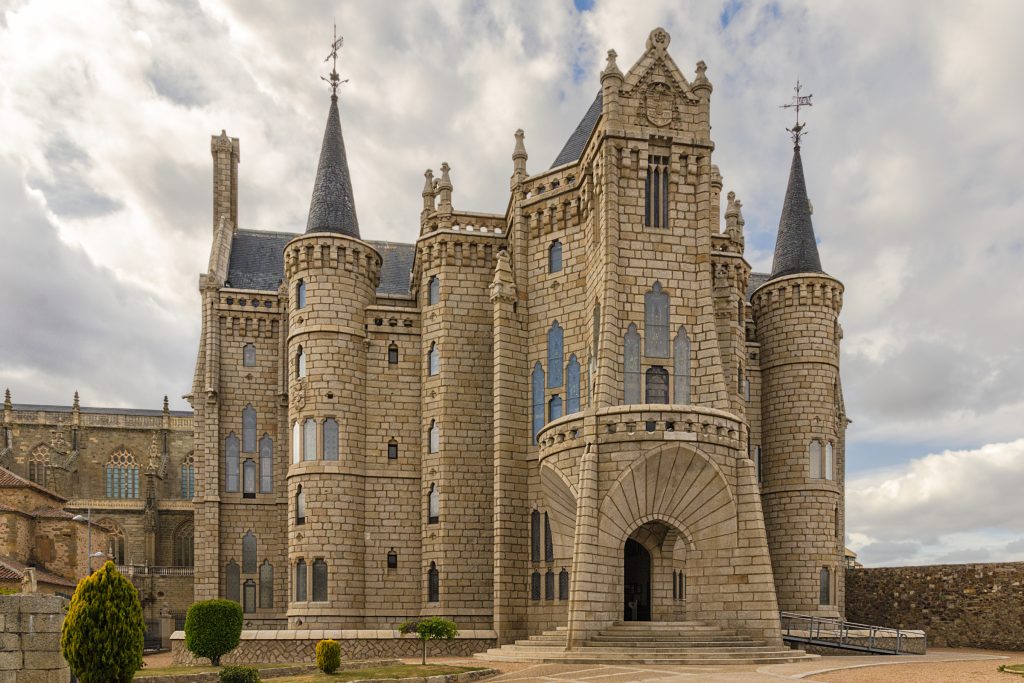
Photo by Javier Montes, CC BY-SA 4.0
Commissioned by the Bishop of Astorga, who happened to be from Gaudí’s hometown of Reus, this castle-like building with stained glass windows and vaulted interiors was one of Gaudí’s most ambitious projects outside Catalonia. It encountered serious problems: the Bishop died mid-construction; disputes with the local committee caused Gaudí to resign; the building wasn’t finally completed until the 1960s, long after his death.
The project that was never built: a hotel in New York
This one tends to stop people. In 1908, two American businessmen approached Gaudí with a commission: a luxury hotel in Manhattan. His design, a rounded, tapering skyscraper inspired by his organic geometry, would have been extraordinary. For reasons that remain unclear, it was never built. The sketches survive. It would have looked like nothing else in New York, then or now.
He was also approached, separately, about a pier for the port of Casablanca. Neither project left the drawing board. History is full of buildings that weren’t built. Gaudí’sghost skyscraper is one of the more haunting ones.
Why he still matters
In an era of glass towers and algorithmic design, Gaudí is a useful interruption. He reminds us that efficiency and beauty are not opposites that a structure can distribute weight and catch your breath simultaneously. That ornament can carry meaning. That a city can feel human even when it is monumental.
But perhaps more than his buildings, it is the arc of his life that stays with you. A dandy who became an ascetic. A man mistaken for a beggar on the street. An architect whose greatest work will be completed a century after his death, by generations he never met, following models he left behind.
He didn’t just design buildings. He designed time.
The Sagrada Familia is expected to be fully completed this year (2026), one hundred years after Gaudí was buried in its crypt. It will be the tallest church in the world. And somewhere in its geometry, in every catenary curve and branching column, the child who once lay in the Catalan fields watching how bones distribute weight is still, quietly, at work.
Related Posts