Cultural Capital of April: Naples
The Historic Center — A City as a Living Text
Naples in April feels like a city that finally allows you to come closer — not through noise, heat, and dense tourist flows, but through soft light and slowly unfolding layers of memory. The historic center is the right place to begin, not as a checklist, but as a living organism.
The narrow line of Spaccanapoli cuts through the city with almost architectural precision, guiding you past churches, workshops, and apartments where life happens directly on the street. It is here that Naples first reveals its rhythm: unfiltered, immediate, and deeply continuous.
A quiet pause can be found in the Complesso Monumentale di Santa Chiara, where the cloister — lined with hand-painted majolica tiles — offers a rare sense of order within the surrounding intensity. Not far away, the Cappella Sansevero holds the Veiled Christ, a sculpture so precise and delicate that it seems to suspend time rather than represent it.
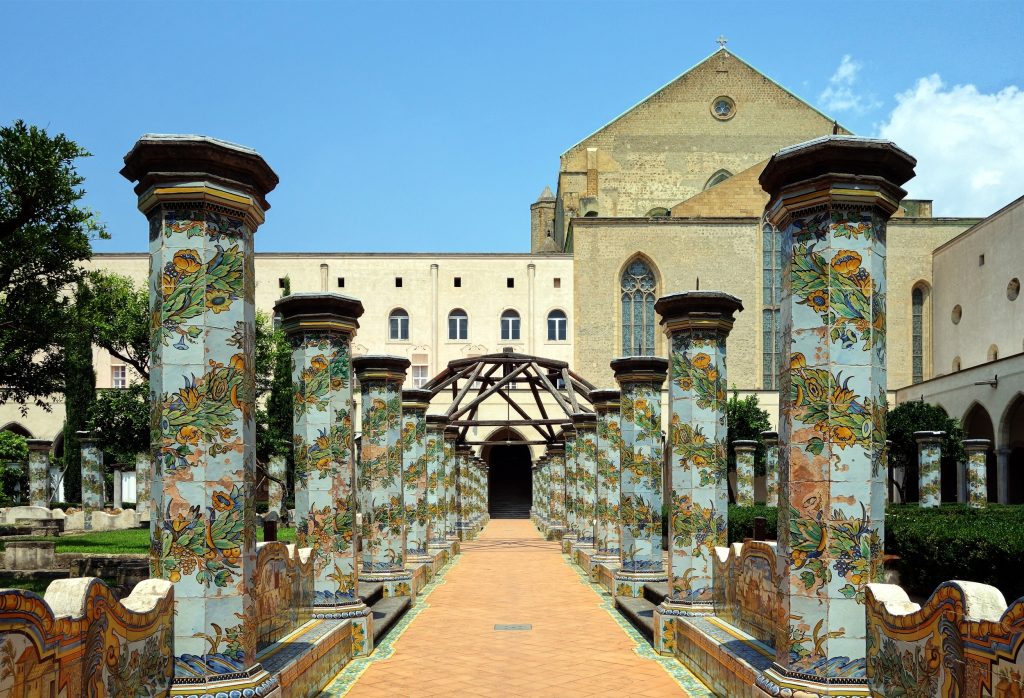
View of the monastery and the basilica from the majolica cloister. Photo by Velvet, CC BY-SA 3.0
Ferrante’s Naples — Rione Luzzatti and the Edge of the City
If Naples is read through Elena Ferrante, it becomes a city structured by tension — between intimacy and escape, belonging and departure.
The neighborhood most closely associated with her work is Rione Luzzatti, located in the eastern part of the city. This is not a place that appears on traditional itineraries, and it does not attempt to present itself. It is here that the emotional architecture of the Neapolitan Novels takes shape: a space defined by proximity, constraint, and the constant pressure of becoming.
Walking through Rione Luzzatti is not about landmarks, but about atmosphere — courtyards, staircases, voices, the physical closeness that defines relationships. It is a Naples that is not curated, but lived.
For a more accessible approach to this layer of the city, districts such as Rione Sanità offer a similar density of everyday life, where the boundary between private and public space dissolves. Here, visiting the Catacombe di San Gennaro adds another dimension: an encounter with early Christian Naples, where time extends downward as much as forward.
Ferrante’s Naples is not a destination.
It is a condition.
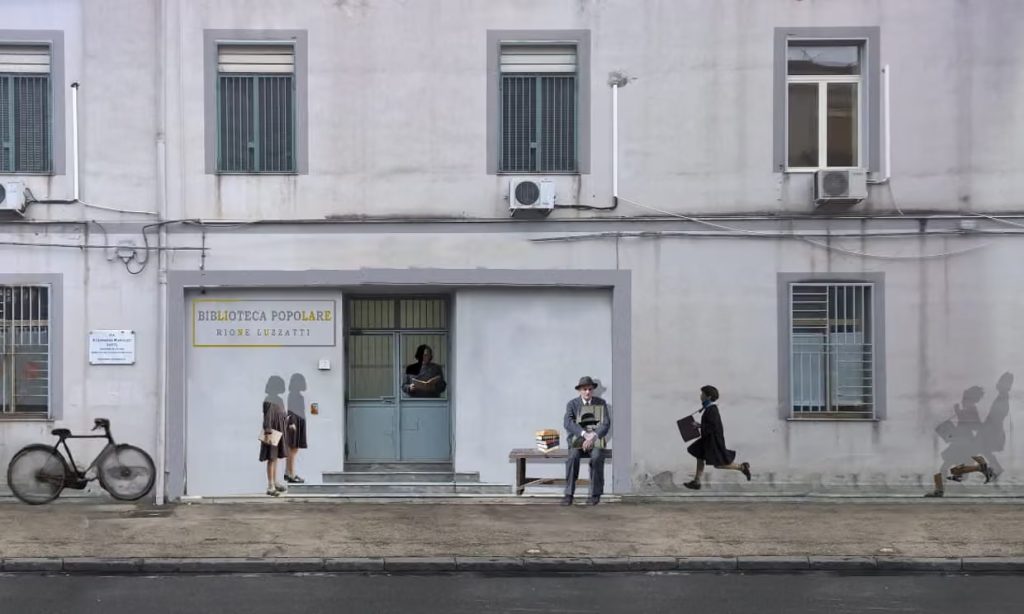
The artwork on the library in Rione Luzzatti, Naples, by Eduardo Castaldo. Photograph: Eduardo Castaldo
Underground Naples — A Vertical City
To understand Naples, one must move not only through it, but beneath it.
The experience of Napoli Sotterranea reveals a second city — ancient aqueducts, hidden tunnels, spaces shaped by necessity rather than design. What is striking is not only their history, but their continuity: these structures were used, adapted, and inhabited across centuries.
Naples is vertical in a way few cities are. Above, life spills outward into streets and balconies. Below, history remains intact, quiet, and unresolved. This layering is not symbolic — it is structural. The past here does not disappear; it accumulates.
Art and Distance — Capodimonte
To remain only in the historic center is to see Naples too closely. Distance is necessary.
The Museo e Real Bosco di Capodimonte, located slightly removed from the city’s density, offers that shift in perspective. Inside, works by Caravaggio, Titian, and the Neapolitan school place the city within a broader artistic context. Outside, the surrounding park opens into space and light.
In April, this balance becomes especially clear. The intensity of Naples does not vanish — it becomes legible.
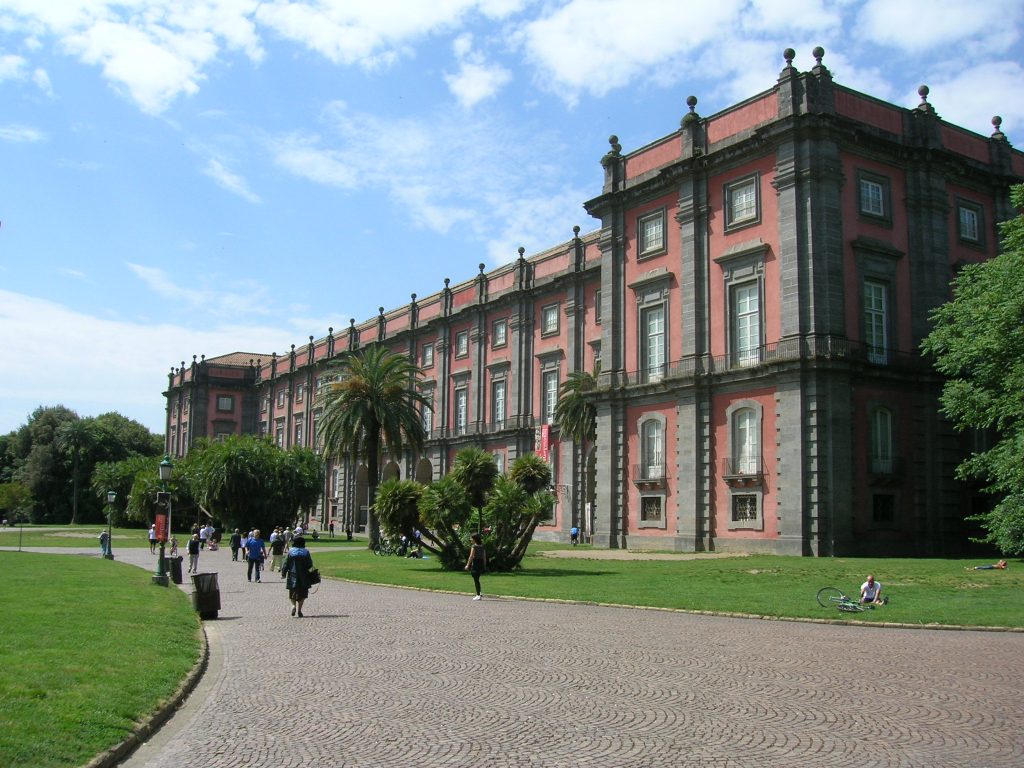
Palace of Capodimonte. Photo by Mentnafunangann, CC BY-SA 4.0
Evening Naples — Teatro di San Carlo
As the day recedes, Naples reorganizes itself.
The Teatro di San Carlo, one of the oldest opera houses in Europe, represents a different discipline of the city — one defined by precision, continuity, and form. Its presence is not separate from Naples, but parallel to it.
To enter San Carlo is to understand that Naples has always contained both excess and structure, spontaneity and composition.
The Sea — A Line of Clarity
Naples ultimately resolves itself at the edge of the sea.
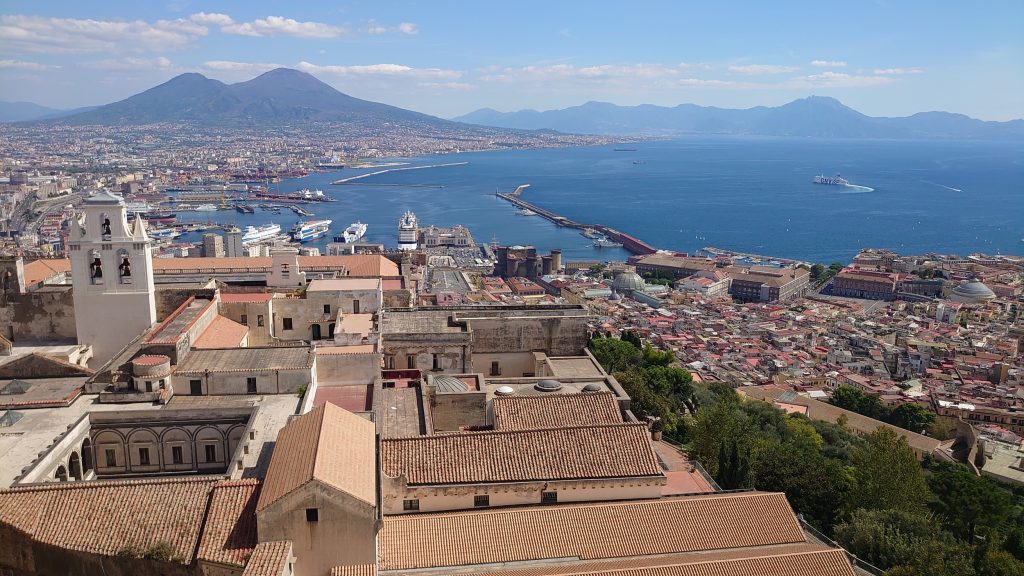
Castel Nuovo viewed from Castel Sant’Elmo to the north west. Photo by Richard Nevell, CC BY-SA 4.0
Along the Lungomare, the city opens. The density softens, the horizon stabilizes, and Vesuvius becomes not a threat, but a constant. In April, the light is particularly clear — neither harsh nor fading, but balanced.
It is here that Naples becomes, briefly, understandable.
Related Posts