The Tree Archetype: From the First Myths to Modern Art
By Dmitri Yusov | Anno Media
How one symbol connects heaven and earth, memory and identity
A tree drawn by the sea
On a quiet beach, a family gathers not only to celebrate a birthday, but to draw a tree together. It is a simple gesture, almost childlike. And yet it carries something ancient, something that connects this particular afternoon to ten thousand years of human meaning-making. Because across civilizations, across millennia, the tree is never just a tree. It is a map of the world. A diagram of life. A memory of who we are.
The first symbol: the world tree
In mythologies predating monotheism, humanity imagined the universe as structured around a single great tree. In Norse tradition, Yggdrasil, the immense ash whose branches reach the heavens and whose roots descend into the underworld, binds the nine worlds together, threading gods, humans, giants, and the dead onto one living axis. In Mesoamerican cosmology, the sacred Ceiba tree performs the same function: its canopy shelters the sky, its trunk anchors the living world, its roots penetrate the realm of the dead. Across ancient Persia and the Vedic traditions of India, cosmic trees sustain both life and knowledge, their fruit simultaneously nourishing and illuminating.
Scholars call this structure the axis mundi, the center of the world, the vertical spine around which all existence is organised. What is striking is not simply that these cultures imagined a cosmic tree, but that they imagined it in the same way: vertical, layered, alive. Roots reaching into the past. A trunk standing in the present. Branches extending toward an open future.
The tree, in other words, was the first diagram. Before writing, before maps, before philosophy the tree was how humanity represented time, space, and the place of the living within both.
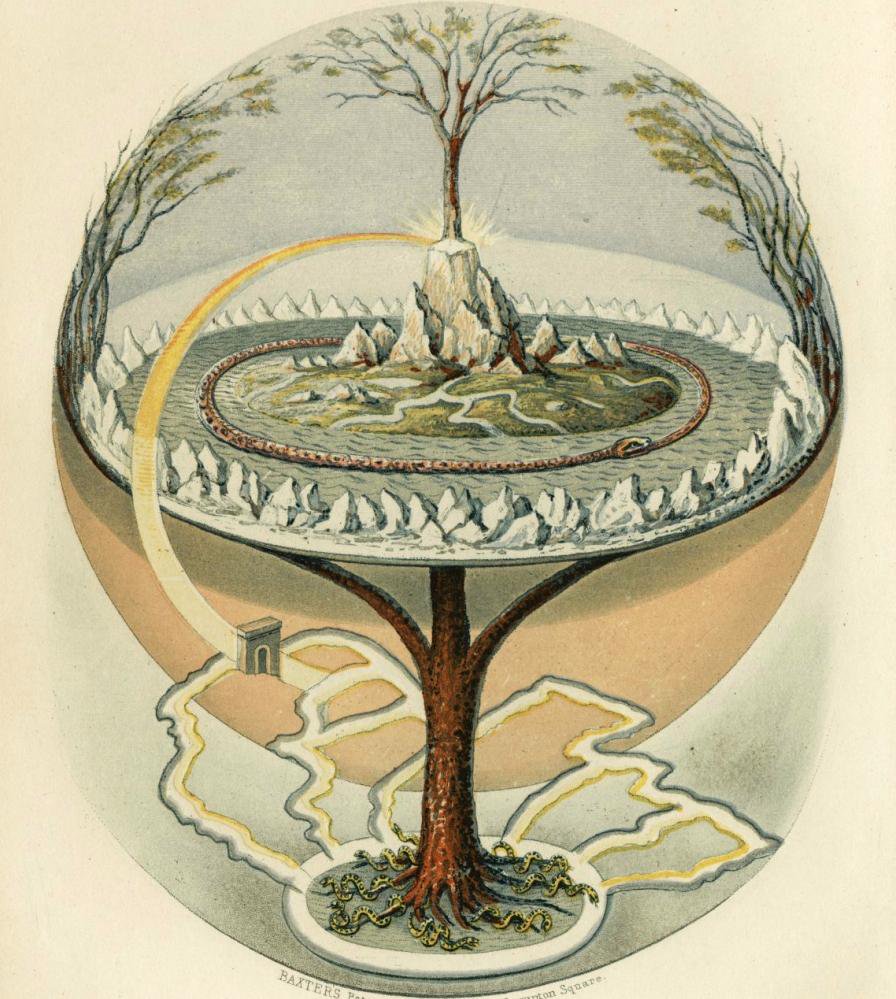
From Northern Antiquities, an English translation of the Prose Edda from 1847. Painted by Oluf Olufsen Bagge.
The Christian tree: knowledge, fall, and redemption
Within Christianity, the tree becomes the hinge on which all of human history turns. Two trees define the entire arc of the faith: the Tree of Knowledge in Eden, where the possibility of choice and therefore of moral life enters the world; and the Tree of Life, whose fruit promises a return to what was lost. These are not decorative details. They are the architecture of the story.
Medieval art elaborates the tree into something even more intricate with the development of the Tree of Jesse, a genealogical image depicting the lineage of Christ growing upward from the sleeping body of Jesse, David’s father. Here the tree becomes history made visible, salvation structured like growth. Branches proliferate, prophets and ancestors cluster among the leaves, and at the crown sits the Virgin and Child. The whole of sacred lineage rendered as a single organism.
Even the cross itself, in certain theological traditions, is understood as a tree, a dead wood that becomes living, a bridge between death and rebirth. The instrument of execution transforms into the axis mundi. The tree endures, even in the shape of its own negation.
Renaissance to Romanticism: nature becomes emotion
With the Renaissance, trees entered the painted landscape as elements of order and geometry — classical in posture, harmonious in composition, subordinate to human figures and architectural grandeur. They were background, not subject. Their presence organized depth and light; their meaning was decorative rather than symbolic.
Romanticism inverted this entirely.
In the paintings of Caspar David Friedrich, the tree becomes the most eloquent figure in the canvas. A lone, leafless oak on a cliff edge against a winter sky. A cluster of firs fading into fog. A dead trunk rising from snow. These are not incidental details; they are the emotional subject of the work. Friedrich understood that a tree stripped of leaves carried the same psychological weight as a human figure stripped of hope and that a great, gnarled tree reaching toward a storm-lit sky could express the sublime more powerfully than any human gesture.
The Romantic tree is a mirror of the interior. Broken, it reflects grief or loss. Solitary, it reflects the individual consciousness set against an indifferent universe. Reaching, it reflects the aspiration toward something beyond the self. For the first time in Western art, the tree stops being backdrop and becomes protagonist.
Latin America: the tree of memory and magic
In Latin American art and literature, the tree gathers all of these previous meanings – cosmic axis, moral symbol, emotional landscape and deepens them with a specifically American weight: the weight of colonial history, of disrupted roots, of identity rebuilt from fragments.
Gabriel García Márquez never explicitly compares the Buendía family to a tree in One Hundred Years of Solitude, but the architecture of the novel reads like one. Generations repeat and diverge like branches. Names recur like rings in wood. Memory accumulates, grows wild, circles back on itself. The family unfolds not in linear time but in biological time – growth, repetition, eventual exhaustion. To read the novel is to watch a tree live out its full span.
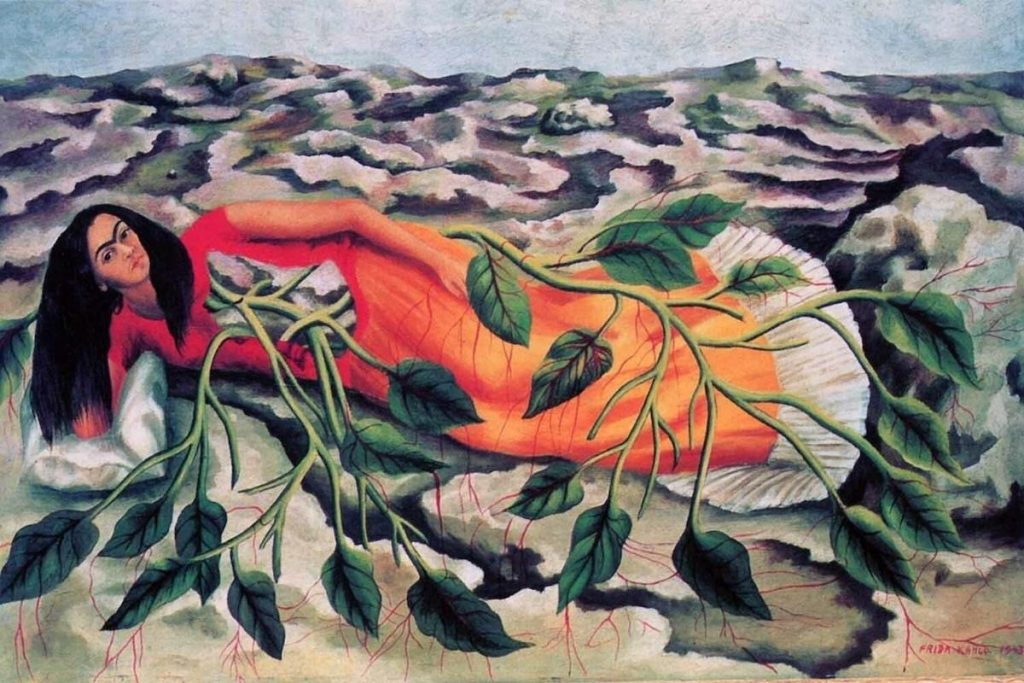
In the work of Frida Kahlo, the metaphor becomes literal and physical. Her body, in painting after painting, is rooted to the earth, to Mexico, to the pre-Columbian past that colonial history tried to sever. In The Broken Column (1944), her spine is rendered as a crumbling classical pillar, but the imagery surrounding it – the corset, the nails, the cracked terrain evokes a tree whose heartwood has been split. Roots, for Kahlo, are not a gentle metaphor. They are the stakes of identity itself. To be uprooted is not a loss of place but a loss of self.
Here the tree is no longer merely symbolic. It is biographical.
Modern and contemporary art: fragmented roots
The twentieth century did not abandon the tree, it took it apart to see what it was made of.
Gustav Klimt transformed it into pure ornament: in The Tree of Life (1905–09), the branches become flat, golden spirals, the whole canvas a shimmering pattern in which organic growth and decorative abstraction are indistinguishable. It is eternal and immediate at once, a symbol so distilled it has become texture.
Piet Mondrian traced the opposite trajectory. Beginning in the early 1900s, he painted a series of trees, realistic, then impressionistic, then increasingly skeletal that document, in slow sequence, the progressive dissolution of the figure into structure. By the end of the series, the tree has become a grid: a horizontal and vertical tension, pure relationship, pure form. What remains is not the tree’s appearance but its underlying logic. Mondrian found abstraction by following one tree to its essence.
Contemporary artists have pushed further, asking not what the tree means but what happens when it fails. Installations of uprooted trees – roots exposed, trunks inverted have become a recurring form in environmental art, staging rootlessness as crisis. The tree, once the symbol of order and continuity, becomes the emblem of displacement, ecological rupture, the anxiety of a world in which roots no longer hold.
The question has shifted. It is no longer: what is the tree? It is: what remains when the roots are broken?
The tree today: a quiet ritual
Return now to the beach. A family draws a tree. Children watch. The sea moves behind them. Nothing monumental is happening and yet, in the light of everything that has come before, everything is.
The gesture is ancient. The impulse to draw a tree when you want to explain who you are, where you come from, what you hope will remain, that impulse connects this afternoon to every civilization that has ever looked for a way to map its own existence. The tree persists as a way to remember, a way to belong, a way to imagine continuity even in the face of everything that changes.
We still draw trees when we need to say something that other shapes cannot hold.

Epilogue: why the tree endures
The tree survives every era because it solves a fundamental human problem, one that philosophy, religion, and art have all circled without ever fully resolving: how do we connect earth and sky, past and future, self and world? How do we make visible the fact that we are rooted in something we did not choose, and reaching toward something we cannot yet see?
Every civilization has found its own version of the answer. And again and again, across languages and centuries and wildly different cosmologies, the answer takes the same form.
We draw a tree.
Related Posts