Cultural Capital of May: Lisbon
by Anno Media | May 1, 2026
Lisbon does not announce itself. It does not perform its history. It tilts toward the river and waits. In May, something shifts, the light lengthens, the jasmine opens in the walls of Alfama, and the city reaches a particular equilibrium: warm without being harsh, alive without being crowded. This is when Lisbon becomes fully readable.
It is one of the oldest capitals in Europe, older than Madrid or Paris, and yet it carries its age without ceremony. The 1755 earthquake destroyed much of what came before and forced a reinvention so precise and rational – the Pombaline grid, the anti-seismic cage of timber beneath every building that Lisbon became two cities simultaneously: the medieval remnant on the hills and the Enlightenment city in the plain. May holds both in the same light.
A City That Looks West
Most European capitals face inward. Lisbon faces the Atlantic.
This is not merely geographical. For two centuries, Lisbon was the administrative centre of the world’s most extended empire not through conquest alone but through navigation, cartography, obsessive precision. The ships left from Belém and the world arrived back changed. What remained in Lisbon was not only wealth, but a particular psychological condition: the awareness of absence, of departure, of things that cross the horizon and do not return.
The Portuguese called it saudade. It is an untranslatable word, routinely mistranslated as nostalgia. It is not that. Nostalgia is passive, comfortable, backward-looking. Saudade is structural – a longing for something whose loss is itself transformative. It shapes the architecture, the music, the tempo of the city. In May, walking along the Tejoat dusk, you will feel it before you have a word for it.
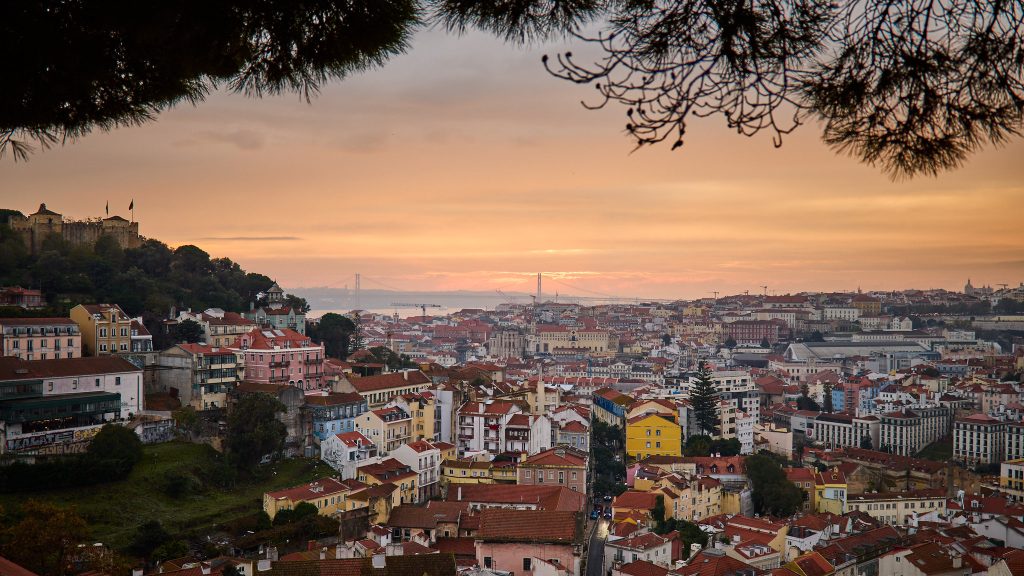
“Lisbon” by barnyz, CC BY-NC-ND 2.0
Belém – The Edge of the Known World
Begin where the departures began.
The Torre de Belém and the Mosteiro dos Jerónimos stand at the point where the Tejomeets the sea, built at the moment when Portugal was redefining what the world meant. The Manueline architecture, the style unique to this moment and this place, is unlike anything else in Europe: nautical ropes carved in stone, coral and armillary spheres, the visual vocabulary of a civilization that had just circumnavigated Africa and reached India. It is baroque before baroque, excessive in a way that feels earned rather than decorative.
But Belém is not only a monument to departure. The Museu de Arte, Arquitetura e Tecnologia (MAAT), built in 2016 on the riverfront, places contemporary art directly in dialogue with the industrial past. Its white undulating form along the water is itself a statement about how Lisbon approaches its own history: not preservation as suspension, but conversation across centuries.
In May, the gardens along the riverside are in full colour. The pastéis de Belém, at the original Casa Pastéis de Belém nearby, come with warm custard and cinnamon, unchanged since 1837. Some continuities require no interpretation.
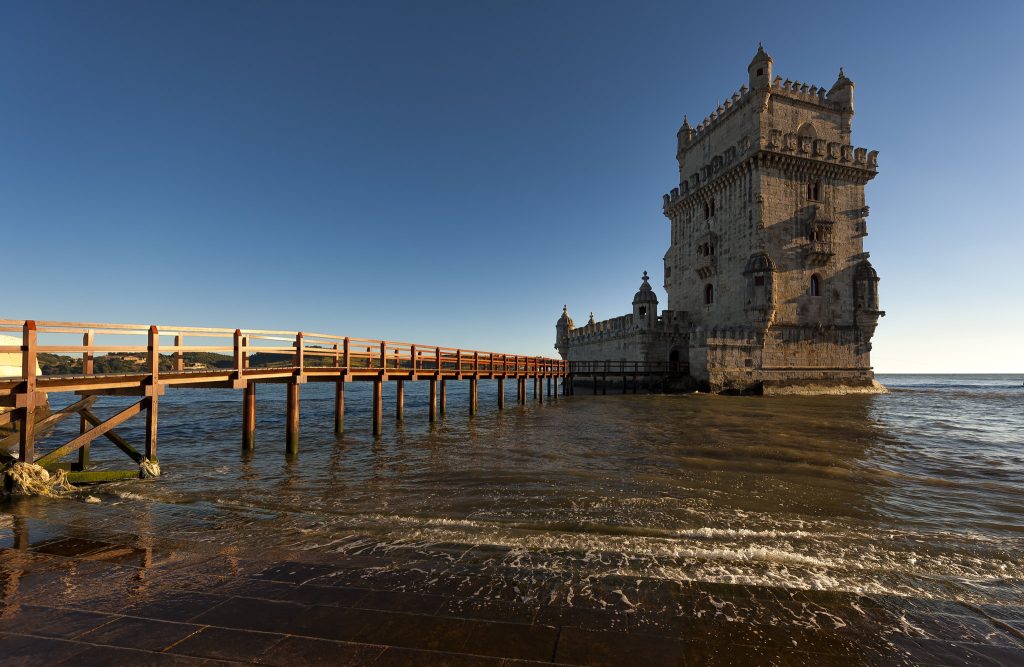
Tower of Belém by Pedro Albuquerque, CC BY-NC-SA 2.0
Pessoa’s City – Baixa and the Art of Disappearing
Fernando Pessoa walked this city and made it plural. Not one Lisbon, but many, each inhabited by a different self, a different name, a different philosophy. He called them heteronyms: Alberto Caeiro, Ricardo Reis, Álvaro de Campos. Each was fully formed, with biographies, astrological charts, poetic styles. Pessoa did not write underpseudonyms; he became other people.
This is the deepest clue to how Lisbon should be read.
The Baixa Pombalina, the grid laid out after the earthquake, is a city of surfaces. Rational, measured, repeatable. Walk its streets in May and the uniformity is almost meditative: the same proportions, the same limestone, the same iron balconies. But step off the grid and the city fractures immediately, climbing toward Chiado or descending toward the river in ways the plan cannot contain.
The Livraria Bertrand, on Rua Garrett in Chiado, is the oldest operating bookshop in the world, founded in 1732. Pessoa is everywhere here, in translation, in critical editions, in postcards, in the simple fact that Lisbon has produced one of the 20th century’s most formally radical writers from this modest, tilted, river-facing city.
Alfama – The City Before the Plan
The earthquake did not reach Alfama. It survives from before the Enlightenment, before rationalism, before the grid.
Its streets are not streets in any conventional senseб they are improvisations, staircases, sudden views, walls that lean toward one another overhead. The neighbourhood descends from the Castelo de São Jorge toward the river in a way that suggests geological rather than urban logic. In May, this is where fado originates each evening from small tascas with no signs and no reservations.
Fado is not background music. It is the acoustic form of saudade – voice, Portuguese guitar, bass guitar, and a silence that must be maintained during performance or the whole thing collapses. The best houses in Alfama are small, lit low, and begin late. The singing is not entertainment; it is testimony.
The Museu do Fado, below the castle in Largo do Chafariz de Dentro, provides context – instruments, recordings, the arc from 19th-century tavern music to Amália Rodrigues to contemporary performers without domesticating the form. History and presence coexist here with unusual care.
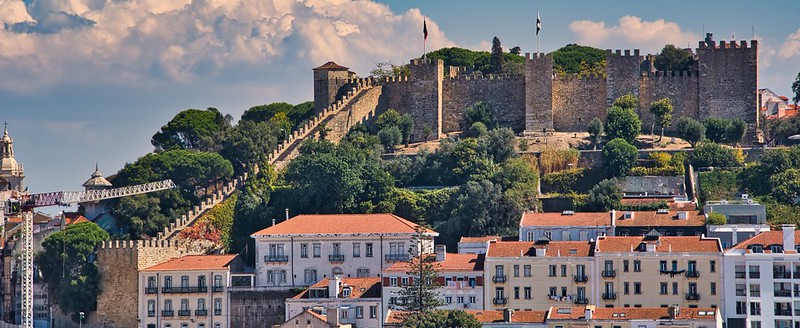
2025 – Spain & Portugal by Train – Lisbon, Portugal – Castelo de São Jorge – 96 of 105” by Ted McGrath, CC BY-NC-SA 4.0
Museums as Conversations
Lisbon’s museums are not collections, they are arguments.
The Museu Nacional do Azulejo makes one of the most quietly radical arguments in European art: that the decorative is also the monumental. The azulejo tradition – blue and white tin-glazed tiles used to cover churches, palaces, train stations, ordinary kitchens represents one of the most sustained acts of visual storytelling in Western culture. Entire histories are painted across the walls of buildings that were never meant to be galleries. In the museum, a 36-metre panoramic tiled panel shows Lisbon as it appeared before the 1755 earthquake. An entire world preserved in ceramic, weeks before it was destroyed.
At the Museu Calouste Gulbenkian, the terms expand again. Gulbenkian was an Armenian oil magnate who chose Lisbon as his final home and left behind a collection of almost pathological breadth: Egyptian antiquities, Islamic art, medieval manuscripts, Lalique jewellery, Rembrandt, Rubens, Monet and a foundation that has shaped Portuguese cultural life for seventy years. The garden surrounding it, in full May bloom, is one of the most civilised spaces in Lisbon. The juxtaposition of accumulation and restraint –the collection is staggering, the presentation is precise – mirrors the city perfectly.
LX Factory – The Industrial Present
Lisbon has not resolved the question of what to do with its industrial past. LX Factory, on the riverbank in Alcântara, is the most interesting non-answer.
A former textile complex from the 19th century, it now holds restaurants, independent bookshops, design studios, fashion labels, galleries, and a Sunday market that feels genuinely unscripted. It is neither museum nor theme park, it is a city within a city, slightly precarious, financially uncertain, and precisely because of this, honest.
The Sunday market, which runs throughout May, is where Lisbon’s contradictions surface most visibly: vintage furniture beside artisan soap, fado records beside electronic music, tourists beside the specific kind of Lisbon creative class that dresses as if they have not tried but clearly have. It is worth several hours of unhurriedattention.
The Trams, the Hills, and the Act of Climbing
No analysis of Lisbon makes sense without the physical experience of its topography.
The city is built across seven hills, a fact always mentioned, never adequately described. To climb from the Baixa to the Bairro Alto is to leave one century and enter another within four minutes and two hundred steps. The Elevador da Bica and Elevador da Glória – funicular lifts embedded in the hillside streets – are not tourist attractions. They were built in the 19th century because people actually needed to get up.
In May, this verticality rewards the patient. Each miradouro – the belvederes scattered across the hilltops – offers a different composition of the same city. The Miradouro da Graça is the least crowded and the most honest. The Miradouro de Santa Catarina belongs to the afternoon. The Miradouro das Portas do Sol, above Alfama, is where the river and the castle and the terracotta rooftops align briefly into something that looks designed, though it is entirely accidental.
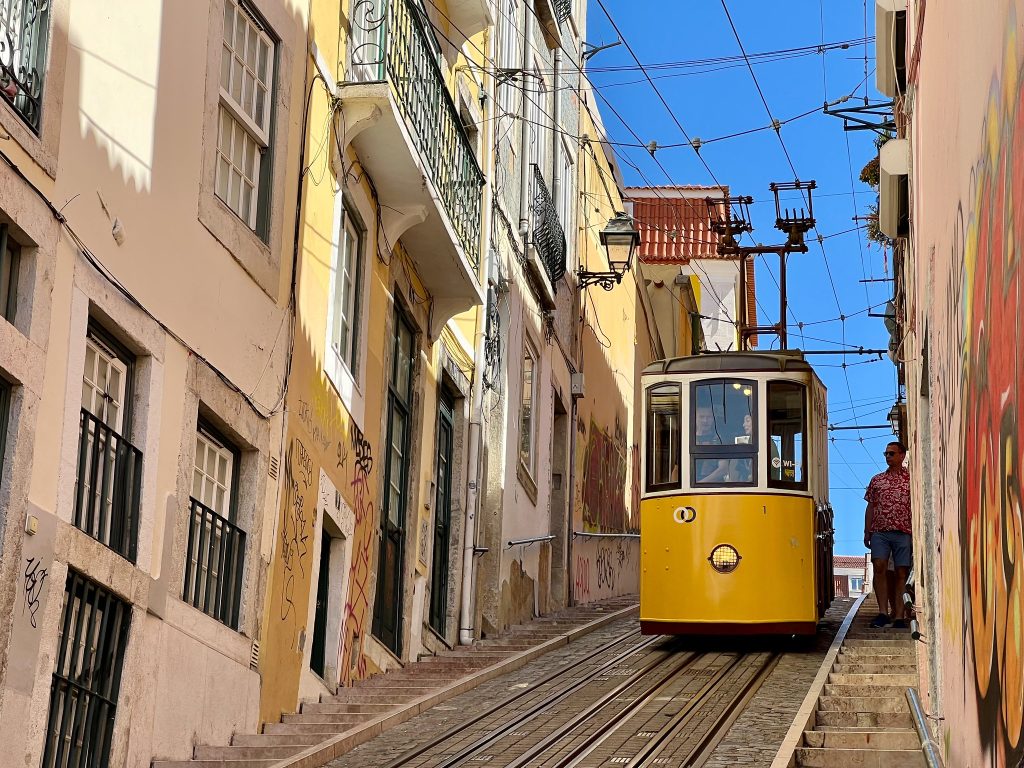
Ascensor da Bica by Ernst Kers, CC BY-NC-SA 2.0
Why Lisbon Belongs to May
Athens was about questions that have no resolution. Naples was about intensity that has no boundary. Lisbon is about something different: the dignified acceptance of impermanence.
The city has been destroyed by earthquake, diminished by the end of empire, isolated by dictatorship for forty-eight years, reawakened by revolution in 1974, and transformed again by tourism in the last decade. None of these events has made it bitter or triumphant. Lisbon absorbs and continues. It is a city that has already survived most of what history offers.
May accelerates this feeling. The light comes early and stays late. The river changes colour across the day from silver to gold to a dark copper at dusk. The jasmine that grows from the walls of Alfama opens fully this month and scents entire streets. The city, so often described as melancholic, reveals something more precise in this light: not sadness, but composure. The knowledge that things end, and the decision to remain present anyway.
This is what Lisbon teaches. Not through monuments or museums, though it has both in abundance. Through tempo, and light, and the river that is always there, always moving, and never coming back.
Related Posts