Gustavo Adolfo Bécquer: The Poet Spain Never Forgot (And the Rest of the World Barely Knows)
by Dmitri Yusov | Anno Media
There are writers whose fame arrives on time. And there are those who have to die first.
Gustavo Adolfo Bécquer belongs to the second kind. He spent his short life in poverty, illness, and obscurity – a poet scribbling verses that almost no one read, in a city that had little interest in what he was doing. He died in Madrid in 1870, at thirty-four, from tuberculosis. His friends gathered his scattered manuscripts, pooled their grief, and published them. Within a few years, he had become the most widely read Spanish poet since Cervantes. He still is.
Outside Spain, almost nobody has heard of him. Which is, in its own way, a kind of literary injustice worth correcting.
A Seville childhood, and an early acquaintance with loss
Bécquer was born in Seville in 1836, the son of a well-regarded local painter. His father died when Gustavo was five. His mother, two years later. He grew up in the household of his godmother, and later with a friend of the family moving between borrowed stability and the understanding, already forming in childhood, that the things you love do not stay.
He came to Madrid as a young man with literary ambitions and quickly discovered that literary ambitions, without money or connections, are largely ornamental. He worked as a journalist, a censor for the government, a sketch-writer for illustrated magazines. He married unhappily. He was ill, often seriously, throughout his adult life. The tuberculosis that would kill him announced itself early and stayed.
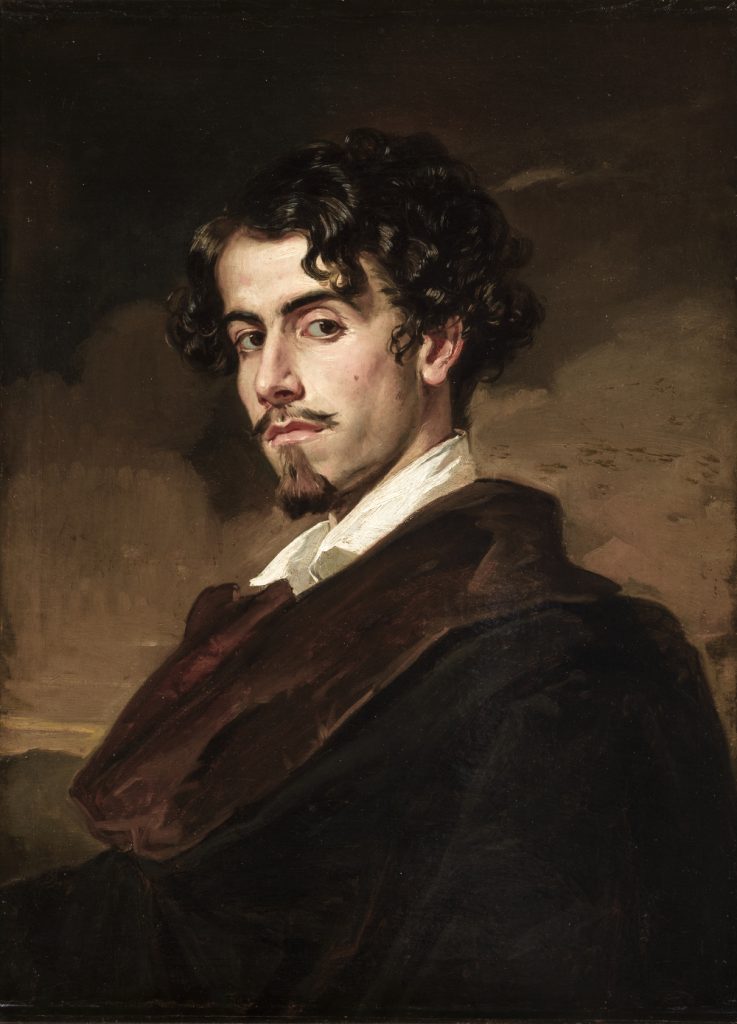
By Valeriano Bécquer – Museo de Bellas Artes de Sevilla., Public Domain
What he left behind: a cycle of poems called Rimas (Rhymes), a series of atmospheric prose tales called Leyendas (Legends), and a handful of letters and essays. Not a large body of work. But concentrated, like a perfume. A few drops fill the room.
What he wrote, and why it still works
Bécquer wrote about love — its arrival, its evasion, its disappearance. He wrote about poetry itself, about the strange compulsion to put feeling into language, about what that act costs and what it gives. He wrote with a simplicity that is harder than it looks, the kind where every word is necessary and none is decorative.
One of his most famous Rimas is just four lines:
¿Qué es poesía?, dices mientras clavas en mi pupila tu pupila azul. ¿Qué es poesía? ¿Y tú me lo preguntas? Poesía… eres tú.
What is poetry? you ask, fixing your blue eyes on mine. What is poetry? And you ask me that? Poetry… is you.
Four lines. No ornamentation. No metaphor to untangle. Just a question, turned inside out, and the answer landing like something inevitable. This is what Bécquer does: he makes the complex feel obvious, after the fact.
He once said that poetry in a person is “a quality purely of the spirit; it resides in the soul.” He wrote as though he believed it completely.
Another Rima – often cited, often remembered:
Por una mirada, un mundo, por una sonrisa, un cielo, por un beso… ¡yo no sé qué te diera por un beso!
For a glance — a world. For a smile — a sky. For a kiss… I don’t know what I would give for a kiss.
Short enough to fit on a napkin. Impossible to improve.
The poem I learned at university – and never forgot
I first encountered Bécquer not as a reader, but as a student with an assignment. This was at MGIMO University in Moscow, in the years when Spanish literature was part of the curriculum in ways that had nothing to do with tourism. The assignment was to translate one of his poems into Russian. The poem was longer, a full cycle of four stanzas, each ending with the same line: hice mis versos yo – I wrote my poems.
The premise is simple. A poet addresses someone – a woman, the reader, an idea of a beloved and explains, in each stanza, why he wrote. To be read with grey eyes. To be sung with a clear voice. To find shelter in someone else’s heart. To carry youth and warmth that the poet himself can no longer give.
I translated it then. The translation is gone. I’ve since translated it again:
So that you might read them with your grey eyes, so that you might sing them with your clear voice, so that your heart might fill with feeling, I wrote my poems.
So they might find shelter in your heart, so you might give them youth, life, warmth —three gifts I cannot give them myself — I wrote my poems.
So you might take pleasure in my joy, so you might share with me my grief, so you might feel the pulse of my life — I wrote my poems.
So that I could lay at your feet all my life and all my love, my soul, broken dreams, laughter, tears — I wrote my poems.
I have known this poem in Spanish by heart for decades. There is something in the refrain, the patient, accumulating repetition of that last line that lodges in the mind the way a melody does. You don’t choose to remember it. It simply stays.
Toledo, a house, and a laurel branch
After my third year at university, I spent a month in Toledo on a summer language course run by the University of Castilla-La Mancha. By that stage I was in the most advanced group, where there was no more grammar or vocabulary drilling, only articles to discuss, lectures, and long walks through the city with our professors.
In Spain, the informal tú levels the distance between teacher and student in a way that rarely happens in Russia. You walk through a medieval city with someone who knows it, and the conversation simply continues without the formality getting in the way.
One afternoon, our group ended up in front of Bécquer’s house. On the outer windowsill lay a branch of laurel. Our Spanish professor told us that laurel mattered to Bécquer –that people brought it regularly, that it meant something. He invited us to take a leaf or two as a souvenir. The others did. I was last in line, and he simply handed me the whole branch. “Take it, Dimitri,” he said. I was surprised, but I took it.
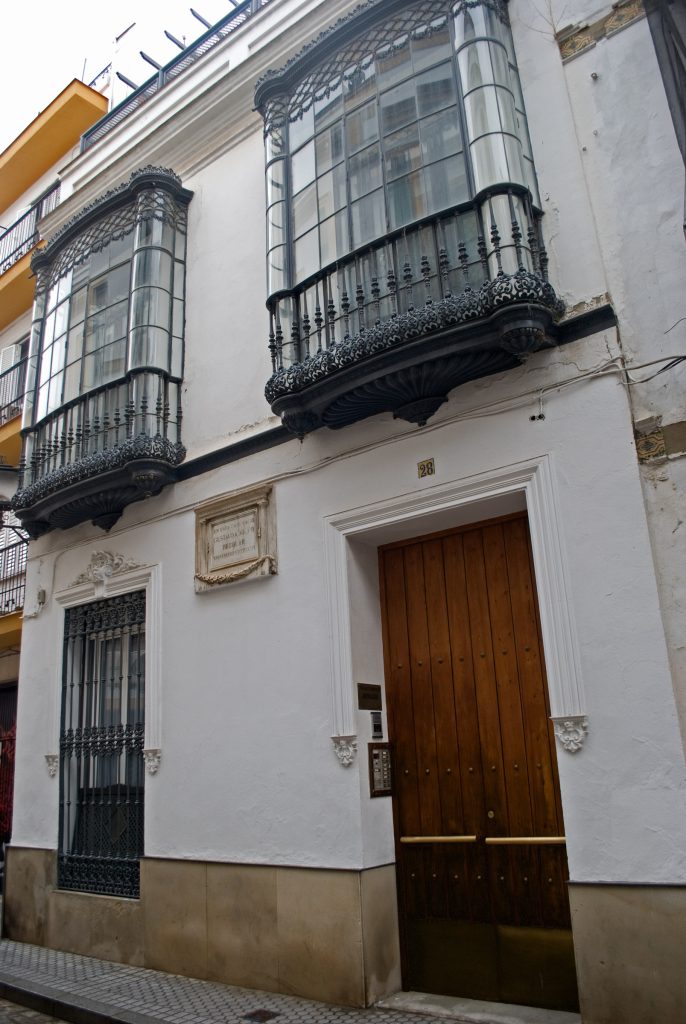
Birthplace of the poet Gustavo Adolfo Bécquer on what is now Conde de Barajas Street, Seville.
I brought it back to Moscow. It sat at my parents’ house for at least ten years.
It was only recently that I thought to ask: why laurel, exactly?
The laurel, and the stories it carries
As it turns out, there are several stories, and they have been growing alongside the tree itself.
Around 1868, a fire destroyed the manuscripts of the Rimas. The poems had to be reconstructed from memory – painstakingly, incompletely, by Bécquer himself in the time he had left. It was around this period that he planted a laurel in the courtyard of his Toledo home. The Spanish read this as something almost prophetic: the poet faded, but the laurel and the fame, the laurels outlasted him.
The tree still stands in that courtyard. At the start of the 20th century, Bécquer’s niece came to Toledo looking for the house where her uncle had lived with the family of his painter brother. The city had changed. She couldn’t find it. She recognized the house, in the end, by the laurel grown large enough by then to be unmistakable.
There is also a legend, a smaller and more human story: Bécquer invented it himself, for the neighborhood children. He told them the laurel was poisonous. It wasn’t. He needed quiet to work.
Today the tree is registered as part of Spain’s Vivero Histórico, the Historical Nursery, recognized as natural and cultural heritage. Shoots from it are planted in schools and cultural centers across the country, in his memory.
A poet who needed silence. A tree he planted after losing his work. Shoots now growing in classrooms.
It is, in its own way, a kind of continuing.
Why it matters to go looking
Bécquer said something that has stayed with me since my Spanish friends sent it recently: Cambiar de horizonte es provechoso a la salud y a la inteligencia. Changing your horizon is good for your health and your intelligence.
He wrote it, presumably, from experience. He moved from Seville to Madrid, from Madrid to Toledo, from ambition to illness to clarity. He changed his horizon repeatedly, and each time something new came through.
Most people outside the Spanish-speaking world will never encounter his name unless they go looking. That seems like a loss worth mentioning. He is not difficult. He does not require context or footnotes. He requires only a little attention, the kind you give to something that is quiet but precise.
A glance. A world. A smile. A sky.
You know the rest.
Related Posts